Thursday

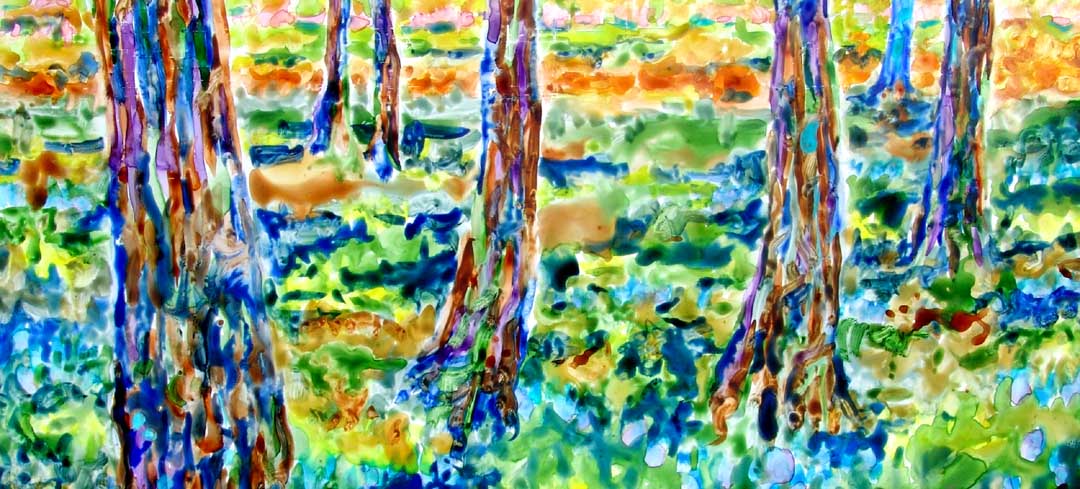
In Praise of Blue

During a recent visit to the Art Institute of Chicago, I spent some time in front of the famous Chagall windows.  I have always related well to his striking use of deep blue.  This got me thinking about my own long-running use of blue in my work and my awareness of how significantly the color of light can change from one geographic location to another.  Any landscape artist worth their salt understands this language of light and color.  The deep blue shadows of a Wisconsin valley will vary by season and time of day.  The color of light on a Wisconsin ridge top will be very different from the mountain colors in the thin, blue-black Colorado air. I credit my long years of experiencing the wide variety of Wisconsin's beautiful land and waters to my having such a deep relationship with blue.  

Wednesday

Slow Death By Bug

I recently traveled to the Colorado Rockies for some much needed relaxation, hiking and change of scenery.  I was not prepared for the change of scenery that awaited me.
Eight years have passed since I visited some of my favorite trails near the Continental Divide. At that time there had been a little tree damage from Mountain Pine Borer Beetles.  Now, the Dillon Reservoir Basin appears as though a forest fire is going through in slow motion. Some areas appear to be 90% dead or dying.  I read that over 3.5 million acres of forest have been killed by the beetles in Colorado so far.


I still found many areas almost untouched and as beautiful as ever. But I have a new respect for the speed at which opportunistic bugs can do their damage.  It will be interesting to see how the ecology of some of these areas changes with the added light to the undergrowth. As a painter of forests, I'm looking forward to how the inevitable renewal will appear.

The Quartzite Cliffs

Wisconsin is blessed with a wealth of geologic features and varieties of landscapes. One of my mainstays for hiking and refreshing is Sauk County.

Sauk County is known for its abundance of pink Baraboo quartzite. The bluffs surrounding Devil's Lake, which resisted the glaciers, offer strokes of pink among the greens and umbers of the blanketing trees. Every season reveals a different palette, but the pink cliffs remain the center of attention for me.

Thursday

Earth Day and Our Looming Water Crises

So much of my artwork has centered around the Great Lakes, and the water in wilderness areas in general, that Earth Day seems like a good moment to reflect upon a looming water crises in our country and world.

States bordering the Great Lakes have joined in a compact to help protect the lakes. This is a small example of steps to address some huge potential issues for our whole species. In the United States, the gigantic Ogallala Aquifer, which provides water for 20% of our irrigated acreage, is showing signs of depletion. The implications for our ability to feed ourselves and the rest of the planet are staggering. Water has been coined as the "new oil" in geopolitical matters. New agricultural technologies which will use water more efficiently will hopefully be available and affordable, and implemented soon.

I stopped taking Wisconsin's beautiful waters for granted decades ago when I first began reading about water pollution and depletion issues. I'm sad that these issues loom larger than ever today.

Saturday

The Paradox of Snow


Although snow has been the subject or part of the subject of many of my paintings, my feelings about it are as ambivalent as ever. While grumbling about my part of Wisconsin being crushed underneath more than a foot of compacted snow and ice with little prospect of melting in the near future, I came across a wonderful archive of snowflake photos. Wilson Bentley devised a method of photographing individual snow crystals decades before the digital era, using a bellows camera, a microscope and a background of black velvet. These photos are amazingly intricate and compelling.


Appreciating the mandala-like quality of Bentley's crystal photos helps to keep me on the more positive side of that paradox-where I can take a fresh look at the prettier side of snow.


Thursday

Monarchs And Milkweed


This year's monarch butterflies have finally departed. I share a fondness with them for the milkweed plant, which I have used as a subject many times. This little illustration is the first I've done in this detailed method. Previously, I've been more inclined to take a more expressionistic view.

Friday

A Very Old Horse

Recently I began a series of paintings based on the plant commonly know as horsetails. When I was very young, I use to find them growing near my home. My neighborhood friends showed me how to snap them apart at the joints to make whistles. Lately they have come back to my attention for how unusual and pretty they look.
When I researched the plant I found some very interesting facts. They are old--very old. They go back in the fossil record over 150 million years to the Paleozoic era, when little trilobites like this one were swimming around this part of the globe. The ancestors of our modern horsetails dominated the understory of the forests during that time. They are also pretty unusual in the way they reproduce via spores rather than seeds.

Up until now I have painted them with the warm golds more representative of the end of the growing season. This example is a detailed portion of a newly completed piece which shows the horsetails in their growing phase.